Water Storage Guide
Water is the single most important thing to store for an emergency. After a large earthquake or typhoon, tap water can stop for days or weeks. This guide explains how much water to keep, how to store it safely, and how to rotate it so it never goes to waste. Written for foreign residents in Japan.
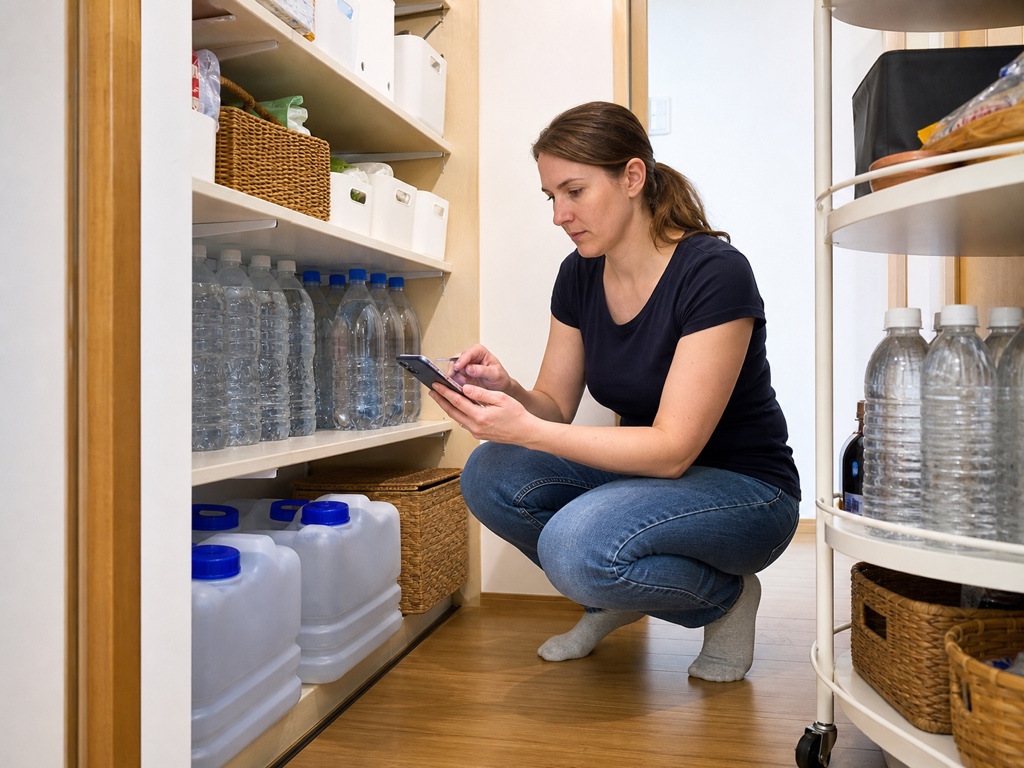
The simple rule
Store 3 litres of drinking water per person per day, for at least 3 days — ideally 7. Remember you also need water for cooking and basic hygiene, so plan for more than drinking alone.
Overview
You can survive a long time without electricity or gas, but not without water. After a major disaster, the water supply is often one of the last utilities to be restored — repairs to underground pipes can take a long time. That is why every household should keep a stored supply that does not depend on the tap.
It helps to think about water in two categories: drinking water (also used for cooking) and non-drinking water (for flushing toilets, washing, and cleaning). Drinking water must be clean and safe, so it needs proper storage and rotation. Non-drinking water can be simpler — even water you fill into a bathtub before an expected outage.
To get exact numbers for your own household, use our Water Calculator. It turns the guideline below into a clear total for the number of people and days you choose.
How much to store
The widely used guideline in Japan is 3 litres of drinking water per person per day. This covers what an adult needs to drink plus a little for cooking. The figure is a rough planning number, not a precise medical one — needs are higher in hot weather, and for people who are pregnant, ill, or very active.
Decide how many days you want to cover. The common minimum is 3 days, but many authorities now suggest aiming for 7 days because a large regional disaster can delay help. A quick way to picture it:
- 1 person, 3 days ≈ 9 litres of drinking water.
- 1 person, 7 days ≈ 21 litres of drinking water.
- A family of 4, 7 days ≈ 84 litres of drinking water.
These are drinking-and-cooking totals only. Add extra for hygiene and cleaning (see non-drinking water below). Do the maths for your exact household with the Water Calculator instead of guessing.
Types of stored water
- Bottled water made for emergency stockpiles keeps for about 5 to 10 years.
- Buy it once, store it, and check the date on the label occasionally.
- Good for the part of your supply you rarely touch.
- Keep extra ordinary bottled water in your cupboard and use it in daily life.
- When you open one, buy a replacement — the stock keeps "rolling" forward.
- Nothing expires unused, and your supply is always fresh.
- Fill clean, sealed containers with tap water for a low-cost supply.
- Because Japanese tap water is chlorinated, it keeps roughly 3 days at room temperature (a little longer if refrigerated).
- Label the fill date and refresh it regularly.
Most households use a mix: some long-life bottles as a base, plus rolling-stock bottled water they actually drink. Storing tap water is a useful top-up, especially just before a forecast typhoon.
A few tips for storing tap water: use a clean container with a tight lid, fill it right to the top so there is little air, and do not open it until you need it. Keep it out of direct sunlight. Because it will not keep for long, treat stored tap water as a short-term supply and rotate it often.
Rotation and expiry
Stored water is only useful if it is still good when you need it. Build a simple habit so nothing is forgotten:
- Write the date on containers of stored tap water and refresh them every few days.
- Check the printed date on bottled water when the seasons change — for example when you review your kit twice a year.
- Use the rolling-stock method for ordinary bottles: oldest first, and replace each one you use.
- If water looks cloudy, smells odd, or the seal is broken, do not drink it — use it for cleaning instead.
Note that a "best before" date on bottled water is about the guaranteed volume and quality, not a hard safety cut-off, but for peace of mind it is simplest to rotate before the date passes.
Non-drinking (living) water
A large share of the water a household uses is not for drinking at all — flushing the toilet, washing hands and dishes, and general cleaning. Planning for this separately means you will not have to spend precious drinking water on it.
- When a big typhoon is forecast, fill the bathtub and spare containers with tap water.
- This gives you a large reserve for flushing toilets and cleaning.
- Empty and refresh it afterwards if it is not used.
- Keep a few clean buckets or jerry cans for carrying and storing water.
- You may need them to collect water from a supply truck or a neighbour's tap.
- Spread bottles across several rooms so a blocked room does not cut off your whole supply.
- Store heavy bottles on low shelves so they cannot fall and injure someone.
Keep non-drinking water clearly separate from drinking water so no one drinks it by mistake — a label or a different container colour works well.
Advice for foreign residents
- After a disaster, your city may set up water supply points (kyūsui) where you can collect water — bring your own containers.
- Register for your municipality's emergency alerts; many offer multilingual notices about water outages and supply points.
- Learn the words mizu (water), kyūsui (water supply / distribution), and danshi (a service stoppage).
- Japanese tap water is safe to drink and chlorinated, which is why it can be stored for a short time.
- Keep some cash — during an outage you may need to buy bottled water, and card readers may be down.
Related tools
Frequently asked questions
How much water should I store per person?
How long does stored tap water keep?
What is "rolling stock"?
Where should I store my water bottles?
What can I do just before a typhoon?
Disclaimer
This guide is general information, not professional or official advice. During an emergency, always follow the latest instructions from your local government and water authority. Verify safety-critical details with official sources.